
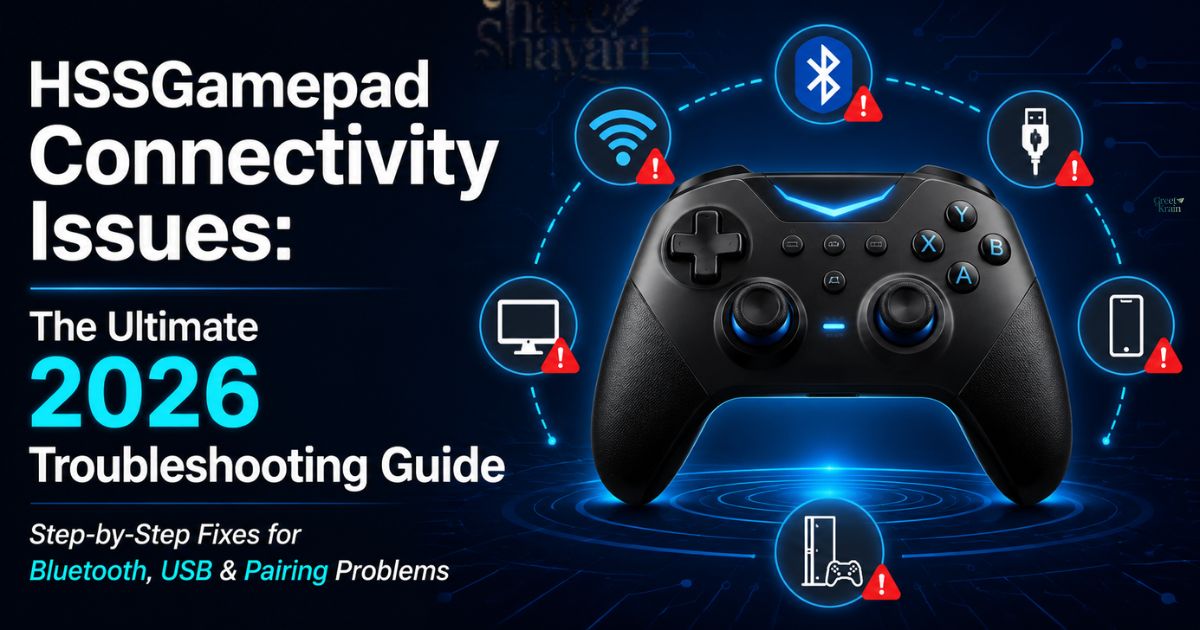
Few things kill a gaming session faster than a controller that won’t connect, or worse, disconnects right in the middle of a match. If you’re dealing with HSSGamepad connectivity issues, you’re not alone, and the good news is that most problems have a quick, straightforward fix.
This 2026 troubleshooting guide covers everything from Bluetooth pairing failures to USB recognition errors, 2.4GHz dongle drops, and input lag. Whether you’re gaming on PC, Android, iOS, or a Smart TV, you’ll find platform-specific solutions built for your exact setup.
We’ll walk through step-by-step fixes, common mistakes users make, and preventive tips to keep your HSSGamepad connected and responsive for the long run. Let’s get your controller back in the game.
What Is the HSSGamepad? (Quick Overview)
The HSSGamepad is a multi-platform wireless controller designed to work across PC, Android, iOS, and select Smart TVs. It supports Bluetooth, a 2.4GHz USB dongle, and wired USB connections, giving gamers flexibility depending on their setup. Its cross-compatibility is one of its biggest selling points, but it’s also why connectivity issues can vary so much from device to device.
Because the HSSGamepad switches between three different connection modes, many users accidentally activate the wrong one or forget to switch modes when changing devices. Understanding how the controller is meant to connect is the first step toward fixing any issue you’re experiencing with it.
Quick Diagnosis – Find Your Problem Fast
Before diving into detailed fixes, it helps to narrow down exactly what type of problem you’re dealing with. Ask yourself: Is the gamepad not pairing at all, disconnecting randomly during gameplay, or connected but lagging? Each of these points to a completely different root cause and fix.
If it won’t pair, jump to the Bluetooth or dongle sections below. If it connects but drops out mid-session, your issue is likely battery, interference, or power-saving settings. If everything connects fine but input feels delayed, your problem is input lag, not connectivity, and has its own dedicated fix further down this guide.
Understanding HSSGamepad Connectivity Issues
Most HSSGamepad connectivity problems fall into a handful of categories: pairing failures, mid-game disconnections, driver/firmware mismatches, and mode conflicts (like D-Input vs X-Input). Knowing which bucket your issue falls into saves you from trying irrelevant fixes.
Environmental factors also play a bigger role than most users realize. Wireless interference from routers, USB 3.0 ports, and other 2.4GHz devices can silently degrade your connection even when everything looks “paired” on screen. Software issues, like outdated Bluetooth drivers or battery optimization settings, are just as common as hardware faults.
Fixing Bluetooth Pairing Issues
Bluetooth pairing issues are the most frequently reported HSSGamepad problem, especially on Android and Windows 11 devices. In most cases, the fix is a matter of correctly entering pairing mode and clearing old, conflicting Bluetooth profiles from your device.
Below, we break this down into three clear steps, starting with getting the gamepad itself into the correct pairing state, since this is where most users go wrong first.
Step 1 – Put the Gamepad in Pairing Mode (The Right Way)
Hold the HSSGamepad’s power button and the pairing button (usually marked with a Bluetooth icon) simultaneously for 3-5 seconds. The LED indicator should begin rapidly flashing blue, confirming pairing mode is active. If the light stays solid or doesn’t turn on, the battery may be too low to enter pairing mode.
Avoid pressing buttons randomly if it doesn’t pair on the first try. Release all buttons, wait five seconds, and repeat the exact sequence, since holding buttons too long can sometimes reset the gamepad instead of activating pairing mode.
Step 2 – Pair It on Your Device
On your phone, tablet, or PC, open Bluetooth settings and select “Add Device.” Look for a name like “HSSGamepad” or “HSS-GP” in the list of available devices. Tap it and wait for the connection to confirm, which is usually indicated by the LED turning solid.
If pairing seems to hang or times out, back out and restart the process from Step 1. Devices with many previously paired Bluetooth accessories sometimes take longer to detect new ones.
Step 3 – Still Not Showing Up? Try These Fixes
If the gamepad doesn’t appear in the list at all, forget any old HSSGamepad entries in your Bluetooth settings first, since a corrupted pairing profile can block new connections. Restart Bluetooth on your device entirely rather than just toggling it off and on.
Also try moving closer to your device, removing physical obstructions, and disabling other Bluetooth accessories temporarily. On some Android phones, disabling and re-enabling Bluetooth permissions for controller-related apps also resolves persistent detection failures.
Fixing USB Connection Issues (PC)
Wired USB connections are generally the most stable way to use the HSSGamepad, but issues still occur, particularly with driver recognition and cable quality. If your PC isn’t detecting the gamepad via USB, start with the cable itself before assuming a software problem.
Many “connection” issues are actually charge-only cables being mistaken for data cables. Confirming your cable supports data transfer solves a surprising number of USB-related reports.
Common USB Problems and Fixes
If Windows shows an “Unknown Device” error, uninstall the device from Device Manager and reconnect it to force a fresh driver install. Try a different USB port, ideally a USB 2.0 port directly on the motherboard rather than a front-panel USB 3.0 hub, which can cause signal conflicts.
If the gamepad connects but isn’t recognized in-game, check that no other controller software (like third-party mapping tools) is intercepting the input signal. Closing background gaming overlays often resolves detection conflicts instantly.
Fixing 2.4GHz Wireless Dongle Issues
The 2.4GHz dongle offers lower latency than Bluetooth but is more sensitive to physical positioning and interference. Most dongle-related complaints come down to placement, driver conflicts, or a dongle that hasn’t been properly synced to its paired controller.
Because the dongle communicates on the same frequency band as Wi-Fi routers, proximity to your router or other wireless devices can degrade signal quality even when the connection technically remains active.
Setting Up the Dongle Correctly
Plug the dongle directly into a rear USB port on your PC rather than a front panel port or USB hub, which often introduces latency. Power on the HSSGamepad and hold the sync button on both the dongle and controller until the LEDs match in blinking pattern, then hold steady.
Avoid placing the dongle behind your PC tower or near other USB 3.0 devices, since this is one of the most common causes of dropped signal reports.
2.4GHz Dongle Not Working?
If the dongle isn’t detected at all, try it in a different USB port and check Device Manager for driver errors. Re-sync the gamepad to the dongle using the sync buttons, since a mismatched pairing between dongle and controller is a common but overlooked cause.
If the connection is unstable rather than absent, move the dongle away from other wireless peripherals and consider a short USB extension cable to reposition it closer to the controller itself.
Also Read This: Socials and Softwares AlienSync in 2026: Features, Setup & Complete Overview
Why Stable Connectivity Matters for Gaming Performance
A stable connection directly affects reaction time, especially in competitive or fast-paced games where even 20-30ms of added latency can mean the difference between a win and a loss. Dropped inputs or micro-disconnections are often mistaken for lag when they’re actually connectivity issues.
Beyond competitive gaming, unstable connections also cause frustration in everyday use, such as menu navigation lag or audio-visual desync in cloud gaming apps. Prioritizing a stable connection setup pays off across every type of gaming session.
Common Connectivity Issues
The most frequently reported HSSGamepad issues include failure to pair, random disconnects mid-session, delayed button response, and the controller being detected but not recognized by specific games. Each of these has distinct causes ranging from software conflicts to physical interference.
Understanding these patterns helps you troubleshoot faster instead of guessing. Most users find their issue fits neatly into one of these categories once they know what to look for.
Basic Troubleshooting Steps
Start every troubleshooting session with the fundamentals: check the battery level, confirm the correct connection mode is selected, and restart both the gamepad and the connected device. These three steps alone resolve a large share of reported issues.
If the basics don’t work, move on to checking for driver updates, clearing old Bluetooth pairings, and testing the gamepad on a second device to rule out a device-specific problem versus a hardware fault.
Fixing Connectivity Issues on Different Devices
Each platform handles controller connections differently, which means the same HSSGamepad issue might need a different fix depending on whether you’re using Windows, Android, iOS, or a Smart TV. Assuming a universal fix works everywhere is one of the most common troubleshooting mistakes.
The platform-specific breakdown further down this guide addresses each of these separately, covering the exact settings and quirks unique to Windows, Android, iOS, and TV operating systems.
Reducing Input Lag and Improving Stability
Reducing input lag starts with choosing the most stable connection type available; wired USB typically outperforms both Bluetooth and 2.4GHz wireless for latency-sensitive games. Closing unnecessary background applications also frees up system resources that can otherwise interfere with signal processing.
Keeping firmware and drivers updated ensures the gamepad is using the most optimized communication protocol available, which often resolves subtle input delays that aren’t obvious during casual use but become noticeable in competitive play.
Preventive Measures
Regularly updating firmware, keeping the gamepad charged above 20%, and avoiding physical obstructions between the controller and receiver all reduce the likelihood of future connectivity problems. Small maintenance habits go a long way toward long-term reliability.
Storing the gamepad properly when not in use, avoiding extreme temperatures, and periodically re-pairing it even when it’s working fine can also prevent gradual connection degradation over time.
D-Input vs X-Input – The Hidden Problem Nobody Talks About
One of the most overlooked HSSGamepad issues isn’t a hardware problem at all, it’s a mode mismatch between D-Input and X-Input. Many older or niche PC games only recognize X-Input controllers, and if your HSSGamepad is set to D-Input mode, the game may not detect it correctly, or button mapping may appear scrambled.
Most HSSGamepad models let you switch modes using a specific button combination, often involving holding “Mode” plus a face button for a few seconds until the LED color or blink pattern changes. Checking your gamepad’s manual for the exact combination and testing both modes in problematic games resolves this issue almost immediately.
Fixing Wireless Disconnection Problems
Random disconnections during gameplay are usually caused by one of four things: low battery, power-saving settings, wireless interference, or an unstable pairing that needs to be refreshed. Working through these systematically resolves the vast majority of cases.
1. Check Your Battery Level First
Low battery is the single most common cause of random disconnects, and many users overlook it because the gamepad still powers on and functions briefly. Check the battery indicator or LED color, which typically shifts to red or starts blinking rapidly when charge is critically low.
Charge the gamepad fully before troubleshooting further, since testing other fixes on a low battery will produce inconsistent and misleading results.
2. Android Battery Optimization (Commonly Missed)
On Android devices, battery optimization settings can aggressively cut Bluetooth connections to save power, disconnecting your gamepad mid-game without warning. Go to Settings > Apps > Battery and disable optimization specifically for Bluetooth and any gaming apps you use with the controller.
This fix is frequently missed because it’s a system-level setting rather than something related to the gamepad itself, yet it’s responsible for a large share of Android disconnection complaints.
3. Reduce Wireless Interference
Other Bluetooth devices, Wi-Fi routers, and USB 3.0 ports operating nearby can all interfere with your HSSGamepad’s signal. Moving your router or other wireless accessories farther from your gaming setup often improves stability noticeably.
If you’re using the 2.4GHz dongle, try repositioning it using a USB extension cable to get it closer to the controller and farther from other electronics.
4. Re-Pair the Connection Fresh
If disconnections persist, forget the device in Bluetooth settings (or re-sync the dongle) and pair from scratch rather than reconnecting to an existing profile. Old pairing data can sometimes carry over corrupted connection parameters.
A fresh pairing resets the communication handshake between devices, which frequently resolves disconnection issues that persistent troubleshooting couldn’t fix otherwise.
Fixing Input Lag
If your HSSGamepad connects reliably but still feels delayed, the issue is likely input lag rather than a connectivity fault. Switching to a wired USB connection typically offers the lowest latency, followed by the 2.4GHz dongle, with Bluetooth generally being the slowest of the three.
Updating your gamepad’s firmware and your device’s Bluetooth or USB drivers can also meaningfully reduce lag, since manufacturers frequently release updates specifically targeting latency improvements.
Platform-Specific Troubleshooting
Different operating systems handle controller input differently, so the same HSSGamepad issue can require a different fix depending on your device. The sections below cover the most common platform-specific problems and solutions.
Windows 10 / 11
Ensure the HSSGamepad driver is updated through Device Manager, and check for Windows Update-related controller driver updates specifically. Windows sometimes installs a generic driver that doesn’t fully support all HSSGamepad features, causing partial recognition issues.
If the controller works in Windows settings but not in-game, verify the game’s input settings are set to recognize the correct controller type (X-Input vs D-Input).
Android
Confirm your Android version is compatible with the HSSGamepad’s Bluetooth profile, as very old or heavily customized Android builds sometimes have compatibility gaps. Battery optimization settings, as mentioned earlier, are a leading cause of Android-specific disconnections.
Some Android games also require enabling controller support manually within the game’s own settings menu, separate from the phone’s Bluetooth pairing.
iOS
iOS is generally stricter about controller compatibility, so ensure your HSSGamepad firmware is updated to the latest version supporting Apple’s MFi-adjacent Bluetooth controller framework. Pairing issues on iOS are often resolved by forgetting the device and restarting the iPhone or iPad before re-pairing.
Not all iOS games support third-party controllers equally, so if one game doesn’t detect the gamepad, test a different app to confirm whether it’s a system-wide or app-specific issue.
Smart TV
Smart TV compatibility varies significantly by brand and model, so check your TV manufacturer’s documentation for supported Bluetooth controller types before assuming the HSSGamepad is faulty. Some TVs require enabling a specific “controller” or “accessory” mode in system settings.
If pairing fails repeatedly on a Smart TV, using the 2.4GHz dongle (if your TV has a compatible USB port) is often more reliable than Bluetooth pairing on TV operating systems.
Updating HSSGamepad Firmware and Drivers
Outdated firmware is behind many persistent connectivity and lag issues that basic troubleshooting can’t resolve. Check the manufacturer’s official companion app or website for the latest firmware version and update instructions specific to your gamepad model.
On PC, keeping both your Bluetooth adapter drivers and USB chipset drivers updated ensures compatibility with the latest HSSGamepad firmware, since mismatched driver and firmware versions can reintroduce fixed bugs.
Preventive Tips: Stop Connectivity Issues Before They Start
Charge your HSSGamepad regularly rather than letting it fully drain, since deep discharges can affect long-term battery and connection reliability. Keep firmware updated even if everything currently works fine, as updates often include stability improvements you won’t notice until an issue arises.
Avoid exposing the gamepad to extreme heat, moisture, or physical impact, all of which can degrade internal components responsible for wireless signal strength over time.
When to Consider a Hardware Issue
If you’ve tried every fix above and the HSSGamepad still won’t maintain a stable connection, physical hardware damage may be the underlying cause. Signs include a battery that won’t hold charge despite full charging cycles, a pairing button that doesn’t respond physically, or connection drops that occur even at close range with no interference present.
At this point, contacting the manufacturer for warranty support or replacement is typically more effective than continuing to troubleshoot software-side fixes that have already been ruled out.
Frequently Asked Questions
Why won’t my HSSGamepad pair with my phone?
This is usually caused by old Bluetooth pairing data, low battery, or the gamepad not being in proper pairing mode. Forget the device, recharge it, and re-pair from scratch.
Why does my HSSGamepad keep disconnecting randomly?
Random disconnects are typically caused by low battery, wireless interference, or Android battery optimization settings cutting the Bluetooth connection.
Is USB or Bluetooth better for the HSSGamepad?
Wired USB offers the lowest latency and most stable connection, followed by the 2.4GHz dongle, with Bluetooth generally being the least stable option.
How do I fix input lag on my HSSGamepad?
Switch to a wired or 2.4GHz connection, update your firmware and drivers, and close background apps competing for system resources.
Why isn’t my HSSGamepad detected on PC?
Check Device Manager for driver errors, try a different USB port, and confirm your cable supports data transfer, not just charging.
How do I switch between D-Input and X-Input?
Hold the Mode button along with a specified face button until the LED changes pattern; check your manual for the exact combination.
Conclusion
HSSGamepad connectivity issues can be frustrating, but they’re almost always fixable with the right troubleshooting approach. From Bluetooth pairing and USB recognition to dongle interference and input lag, most problems trace back to a handful of common causes.
By working through the steps in this guide, checking your battery, connection mode, drivers, and firmware, you can resolve the vast majority of issues without needing a replacement. Platform-specific fixes ensure you’re addressing the actual root cause rather than guessing.
If you’ve exhausted every fix and problems persist, it may be time to consider a hardware issue and reach out for warranty support. With proper care and regular updates, your HSSGamepad should deliver a stable, lag-free gaming experience for years to come.
